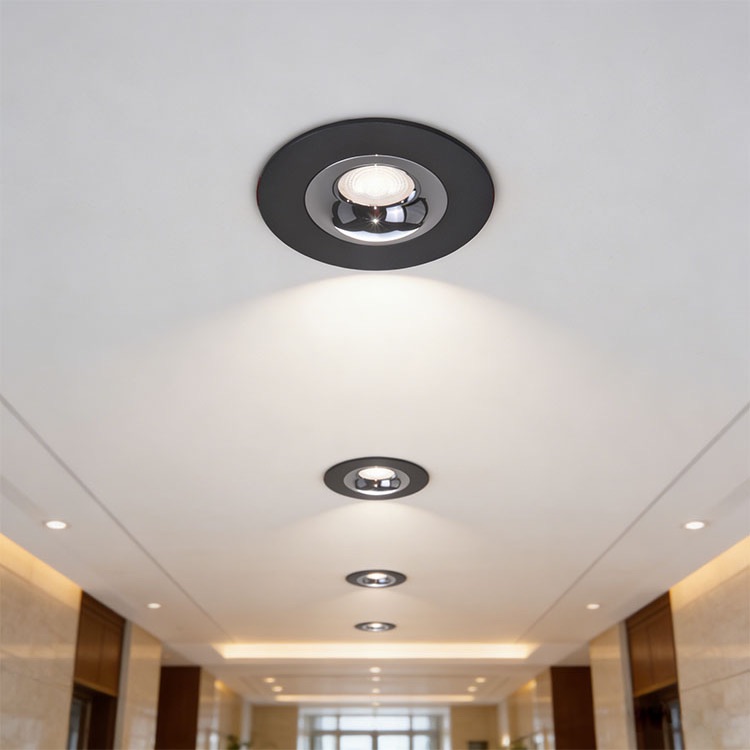
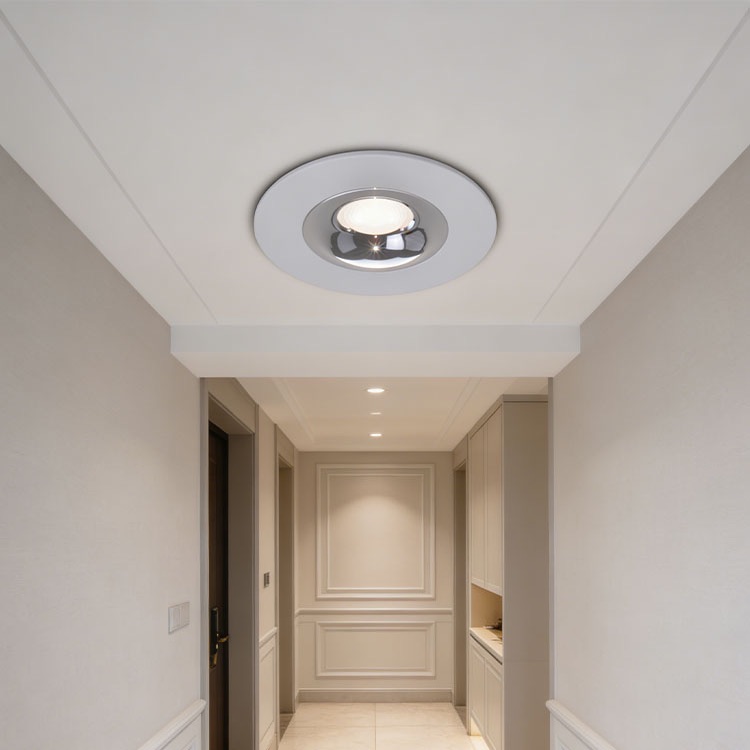
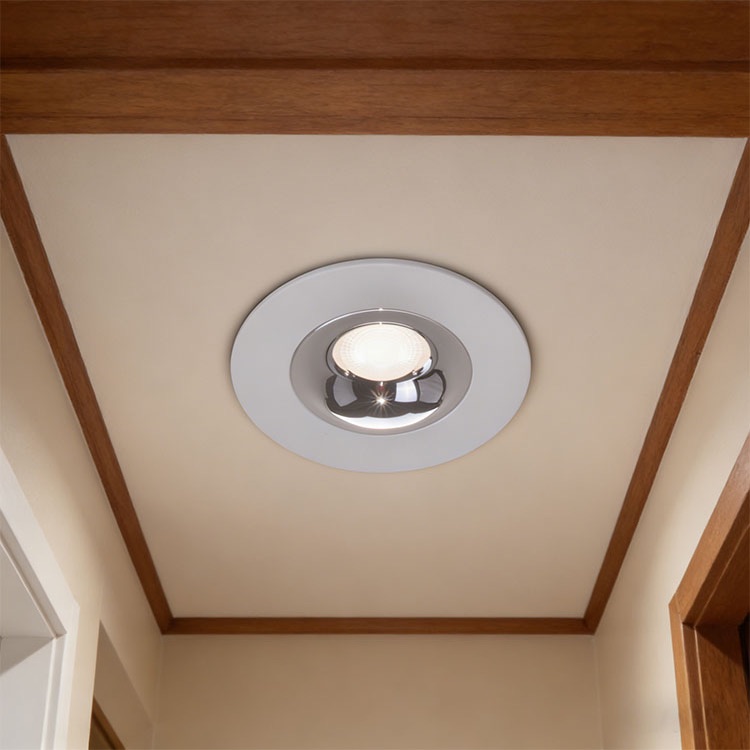
Hotel corridor lighting design is not decoration. It is risk management, guest psychology, energy math, and brand discipline packed into a narrow passageway most owners underfund until complaints start.
When a guest steps out of an elevator at 11:47 p.m., half-awake, carrying a phone, a card key, and maybe a suitcase, the corridor ceiling cannot behave like a showroom because every bright dot becomes a small accusation. Why are we still pretending a hotel corridor is just a line of holes in gypsum?
I’ll say the unpopular part first: most hotel corridor lighting design failures are not caused by cheap LEDs. They are caused by lazy layouts, poor beam control, no mockup, and procurement teams treating downlights as interchangeable white circles.
A good LED downlight for hotel corridor use has to do four jobs at once: guide movement, protect sleep-adjacent ambience, keep faces and door numbers readable, and avoid the hard “airport hallway” feeling that makes a boutique hotel look like a clinic. The fixture is small. The damage is not.
That number matters. It turns “hotel hallway lighting ideas” from a mood-board topic into an operating-cost argument.
The Hard Truth: Downlights Are Not the Design
A downlight is only a tool. The design is the beam, spacing, shielding, CCT, dimming curve, emergency visibility, ceiling coordination, and maintenance plan.
I have reviewed too many corridor concepts where the drawing showed neat rows of recessed downlights but no serious thought about source brightness, door shadows, fire egress visibility, or how the corridor would feel at 2 a.m. That is not lighting design. That is ceiling decoration.
Here is my rule: if guests can see the LED chip from normal walking angles, the specification is already in trouble.
What I Would Specify Before Talking Price
Design Variable
Practical Target for Hotel Corridors
중요한 이유
일반적인 실수
CCT
2700K–3000K for warm hospitality corridors
Keeps the transition from guestroom to hallway calm
Using 4000K because it “looks brighter”
CRI
80 minimum, 90 preferred for premium hotels
Helps skin, art, carpet, and door finishes look credible
Buying only by wattage and lumen output
빔 각도
24°–60°, based on ceiling height and spacing
Controls scalloping, glare, and floor rhythm
Using one beam for every corridor width
Cut-off / glare control
Deep regressed optic, baffle, honeycomb, or louver
Reduces visible source brightness
Choosing shallow trim because it is cheaper
디밍
0-10V, DALI, TRIAC, or system-matched driver
Allows night scene, cleaning scene, and energy control
Mixing drivers that dim unevenly
Emergency visibility
Coordinate with exit lighting and local code
Keeps paths readable during incidents
Treating decorative lighting as safety lighting
문서
IES/LDT, LM-79, wiring notes, shop drawings
Makes DIALux/AGi32 calculations and approval easier
Ordering without photometric files
And yes, documentation belongs in the buying conversation. If a supplier cannot provide IES/LDT files, driver data, and basic compliance paperwork, I would not let that fixture anywhere near a hotel rollout. The site’s LED lighting IES files, BIM Revit, LM-79 reports, and spec sheet resources are exactly the type of support page buyers should use before a mockup.
Hotel Corridor Lighting Standards Are Not Optional Wallpaper
The legal side is dull until it becomes expensive.
OSHA states that each exit route must be adequately lighted so an employee with normal vision can see along the route, and that exit signs must be visible and marked; this is not written as a hospitality design suggestion. It is a safety requirement.
Will every hotel corridor discussion start with OSHA? No. Should the lighting designer, contractor, and owner know where decorative lighting ends and exit-route safety begins? Absolutely.
그리고 U.S. Access Board’s ADA guidance on protruding objects is another overlooked issue. It warns that wall-mounted objects along circulation paths can create hazards for people with vision impairments, and objects with leading edges above 27 inches and below 80 inches are limited to a 4-inch maximum projection in many circulation-path cases.
This is why wall sconces in corridors are not harmless “style.” Badly selected sconces can become compliance headaches. If a designer wants decorative wall lighting, I would check a purpose-built option like an LED decorative wall light used to illuminate hotel corridors and verify projection, mounting height, photometrics, and local code fit before approving it.
Anti-Glare LED Downlights: The Small Detail That Separates Luxury From Cheap
The guest does not know UGR. The guest knows discomfort.
Anti glare LED downlights matter because hotel corridors are narrow, repetitive, and walked from multiple angles. A fixture that looks acceptable in a sample box can become brutal when repeated 40 times down a 30-meter passage.
The main enemies are exposed LED chips, glossy reflectors, excessive lumen packages, bad spacing, and over-bright emergency-night scenes. Recessed downlights for corridors should hide the source, soften the aperture, and distribute light without creating a dotted runway.
A strong specification usually includes:
Deep-set LED source
Matte reflector or low-brightness baffle
Optional honeycomb or louver
Consistent SDCM binning, ideally ≤3 SDCM for premium projects
Flicker-aware driver selection
Dimming compatibility verified before shipment
IES file checked in calculation software before purchase
But here is the procurement trap: “anti-glare” is one of the most abused labels in LED lighting. I would ask for beam angle, cut-off detail, photometric file, installation depth, driver brand, dimming protocol, and sample testing before trusting the word on a product page.
If the corridor ceiling uses square apertures, a square dimmable LED downlight spotlight can make sense where clean geometry and scene control matter. For broader sourcing, the LED Downlights collection gives buyers a faster way to compare recessed, adjustable, dimmable, and hotel-focused variants.
How to Design Hotel Corridor Lighting Without Making It Look Like a Tunnel
Start with the floor plan, not the fixture catalog.
I would mark door locations, elevator lobby transitions, artwork, signage, sprinkler heads, smoke detectors, cameras, access panels, and ceiling joints before placing a single downlight. Why? Because the ugly truth is that corridor lighting often fails at coordination, not imagination.
Step 1: Define the Corridor Mood
A luxury hotel corridor wants warm, low-glare, low-contrast guidance. A business hotel may tolerate brighter, cleaner light. A resort may need wall grazing, decorative sconces, and softer vertical illumination. A serviced apartment corridor may need more practical light at doors and stair entries.
One fixture cannot honestly satisfy all of that.
Step 2: Use Layering, Not Just Repetition
The best LED downlights for hotel corridors rarely work alone. I prefer a layered approach:
Recessed downlights for basic pathway rhythm
Wall washers or decorative wall lights for vertical brightness
Small accent downlights for art, signage, or niche features
Low-level or stair lighting where required
Emergency lighting and exit signage coordinated separately
A corridor with only ceiling dots often feels cheap. A corridor with controlled ceiling light plus soft vertical brightness feels designed.
Step 3: Mock Up One Real Corridor Bay
Do not approve from a PDF.
Test one corridor segment with the actual ceiling height, paint, carpet, wall finish, door finish, and dimming scene. Check it standing, walking, looking back, and exiting the guestroom. Then ask the question owners hate: would I want to walk this hallway after a 14-hour flight?
Step 4: Design the Night Scene Separately
Day mode is easy. Night mode exposes everything.
A practical hotel corridor lighting design often uses lower late-night output, warmer scenes where possible, and enough vertical brightness to read room numbers without blasting light under guestroom doors. Dimming should be smooth. No stepping. No flicker. No driver buzz.
My Practical Specification Bias
I prefer fewer, better-controlled fixtures over more cheap fixtures. That opinion annoys cost controllers, but it usually saves them later.
A corridor filled with low-grade downlights creates three hidden costs: complaints, replacement labor, and brand damage. The LED unit price is visible; the maintenance drag is not. If a hotel has 18 floors, 40 fixtures per corridor zone, and several operating scenes, a small mistake multiplies fast.
For OEM or project-based supply, I would push early for custom LED lighting OEM/ODM support when the corridor needs specific trims, beam angles, finishes, CCT, driver protocols, export packaging, or private-label continuity across phases.
The bitter lesson: “available now” is not the same as “safe for a rollout.”
자주 묻는 질문
What is hotel corridor lighting design?
Hotel corridor lighting design is the planned use of downlights, wall lights, emergency lighting, controls, beam angles, color temperature, and glare management to make guest circulation safe, calm, readable, and code-aware while supporting the hotel brand from elevator lobby to guestroom door.
In practice, it means balancing comfort and visibility. A corridor must not feel dark, but it also should not feel like a hospital passage. The better approach uses low-glare recessed downlights, warm CCT, consistent spacing, vertical light for signs and doors, and separate emergency lighting coordination.
What is the best LED downlight for hotel corridor use?
The best LED downlight for hotel corridor use is a low-glare recessed fixture with a deep optical cut-off, stable driver, suitable beam angle, warm 2700K–3000K CCT, reliable dimming, documented photometrics, and enough lumen output to support safe wayfinding without visible source brightness.
For premium hotels, I would lean toward deep-recessed anti-glare downlights, trimless or minimal-trim designs, and dimmable drivers matched to the control system. For renovation corridors with limited ceiling depth, check housing dimensions before approving the fixture.
How far apart should recessed downlights be in hotel corridors?
Recessed downlight spacing in hotel corridors should be based on ceiling height, beam angle, lumen package, wall reflectance, and target uniformity, but many layouts start with spacing roughly equal to or slightly greater than ceiling height before photometric calculation confirms the final pattern.
Do not copy spacing from another project blindly. A 2.4-meter corridor with dark carpet and bronze wall panels behaves very differently from a 1.6-meter corridor with light walls and glossy stone. Use IES files, calculate, then mock up.
What color temperature works best for hotel hallway lighting ideas?
The best color temperature for most hotel hallway lighting ideas is usually 2700K to 3000K because it supports a warmer, more private hospitality mood while preserving enough clarity for room numbers, signage, artwork, floor transitions, elevator lobbies, and late-night guest movement.
I would avoid 4000K in most guestroom corridors unless the brand intentionally wants a sharp business-hotel feel. Warm light hides fewer sins than people think, but it does make the space feel less institutional when glare is controlled.
Are anti glare LED downlights worth the extra cost?
Anti glare LED downlights are worth the extra cost in hotel corridors because repeated ceiling brightness can cause discomfort, cheapen the interior, disturb late-night ambience, and expose poor spacing, while controlled optics protect visual comfort and make the corridor feel more deliberate.
The extra cost is usually small compared with repainting, replacing fixtures, or handling guest complaints. I would rather reduce fixture count and improve optics than fill a corridor with shallow, high-glare downlights.
How do hotel corridor lighting standards affect fixture choice?
Hotel corridor lighting standards affect fixture choice by forcing designers to think beyond aesthetics into exit visibility, emergency operation, accessible circulation paths, protruding objects, photometric documentation, controls, and local code compliance before selecting decorative or recessed lighting products.
In plain terms, a beautiful fixture can still be the wrong fixture. Check exit-route lighting, emergency power requirements, ADA projection limits for wall-mounted products, local fire code, and the project’s energy code before issuing purchase orders.
Final Thoughts: Treat the Corridor Like a Revenue Space
Hotel corridor lighting design deserves the same discipline as the lobby because it shapes guest confidence before the room door opens.
My advice: choose anti-glare LED downlights, demand IES/LDT files, verify CCT and dimming, run a real mockup, check emergency and ADA constraints, and stop buying corridor fixtures as if nobody will notice them. Guests notice. Owners notice later.
If you are sourcing for a hotel project, start by comparing the site’s hotel-ready downlights, anti-glare recessed options, linear corridor fixtures, and spec documentation support—then request samples, photometric files, and a corridor mockup before locking the order.